
8 Things to Consider Before Buying an Aluminum Pergola

An aluminum pergola can transform an outdoor area into a more comfortable, functional, and attractive living space.
Whether you are planning a pergola for a backyard, rooftop terrace, poolside area, restaurant, hotel, or commercial project, choosing the right product requires more than simply comparing prices.
The material, structure, louvers, drainage system, control options, customization, installation, and manufacturer can all affect the long-term performance of your pergola.
Before placing an order, here are 8 important things to consider when buying an aluminum pergola.
1. Check the Aluminum Quality and Structural Design

The quality of the aluminum profile is one of the foundations of a durable pergola.
For outdoor structures, aluminum alloys in the 6063 series are widely used because of their combination of formability, strength, and corrosion resistance. The Aluminum Association notes that 6063 series alloys are commonly used for architectural and structural extrusion applications.
The Aluminum Association – Standards & Aluminum Information
For buyers, however, the alloy designation is only one part of the evaluation. The profile dimensions, wall thickness, connection design, beam structure, column design, and overall engineering also matter.
A well-designed pergola should be engineered as a complete structural system rather than simply assembled from attractive-looking profiles.
What to check:
| Item | Why It Matters |
|---|---|
| Aluminum alloy | Affects strength, corrosion resistance, and suitability for outdoor applications |
| Profile dimensions | Influences structural stability and overall appearance |
| Wall thickness | Can affect load-bearing performance and rigidity |
| Beam and column design | Important for larger or more exposed structures |
| Connection system | Helps determine installation stability and durability |
| Surface finish | Helps protect the aluminum and maintain its appearance |
Tip: Ask the manufacturer for detailed product specifications instead of judging quality only from product photos.
2. Pay Attention to the Louver Design and Operation
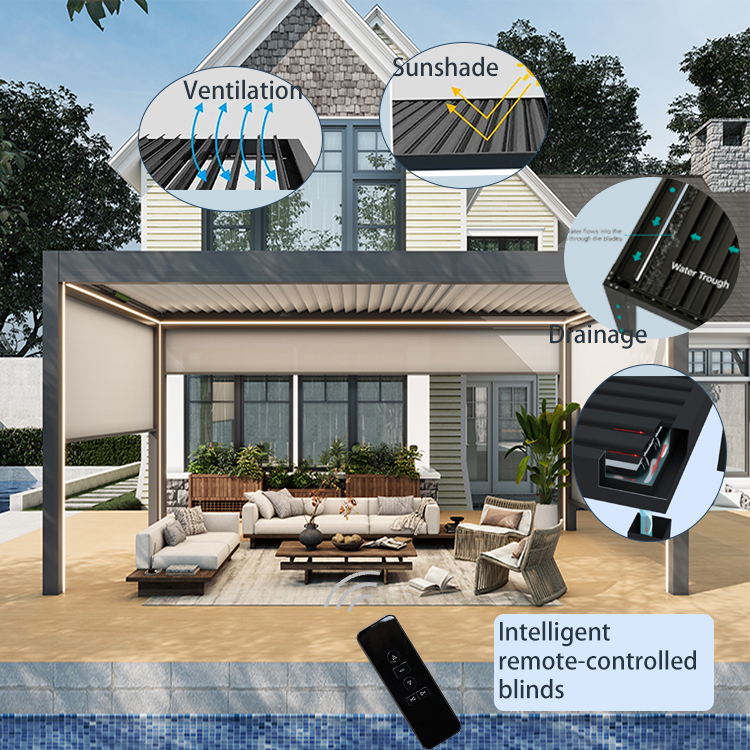
For a modern aluminum louvered pergola, the roof system is one of the most important components.
Adjustable louvers allow users to control sunlight and airflow. When the louvers are open, more sunlight and ventilation can enter the space. When partially closed, they can provide adjustable shade. When closed, they are designed to direct rainwater toward the drainage system.
If you are choosing a motorized pergola, look beyond the remote control itself.
Consider:
- Louver size and thickness
- Rotation range
- Connection and pivot design
- Motor quality
- Operating noise
- Control methods
- Manual override options
- Compatibility with sensors or smart controls
Depending on the project, a pergola may use a manual rocker or hand crank, remote control, smartphone app, voice control, or optional wind and rain sensors.
The right system depends on how you plan to use the pergola.
3. Understand How the Rainwater Drainage Works

One of the most important questions to ask before buying a louvered pergola is simple:
Where does the rainwater go?
When the louvers are closed, rainwater should be guided into an integrated drainage system rather than simply falling from the edge of the roof.
A typical integrated system can guide water from the louvers into drainage channels within the surrounding beams and then through the columns toward designated outlets.
This is particularly important for rooftop terraces, patios, restaurants, and other areas where uncontrolled water discharge could create problems.
Questions to ask the manufacturer:
- How is rainwater collected?
- Where does the water drain?
- Are the gutters integrated into the structure?
- Where are the drainage outlets located?
- Can the drainage system be connected to the site’s existing drainage?
- How can the drainage channels be inspected and cleaned?
- Has the drainage system been tested?
A louvered pergola can provide effective rain protection when the roof is properly designed and installed, but it should not automatically be treated as a completely enclosed waterproof room. Wind direction, rainfall intensity, installation quality, and side enclosure design can all affect actual performance.
4. Choose the Right Size and Layout

Choosing the right pergola size is not simply about measuring the available space.
First consider how the space will be used.
| Outdoor Application | Typical Considerations |
|---|---|
| Small backyard | Seating, dining, or relaxation area |
| Rooftop terrace | Available floor area, access, wind exposure, drainage |
| Poolside | Shade, furniture layout, moisture exposure |
| Restaurant or café | Customer seating capacity, circulation, lighting |
| Hotel or resort | Larger connected structures and customized layouts |
| Villa or large garden | Multiple modules, L-shaped or irregular configurations |
For example, a 3 × 3 m pergola may work well for a compact seating area, while a 3 × 4 m or 4 × 4 m structure can provide more room for dining or lounging.
Larger spaces may benefit from connected or modular structures.
You should also consider:
- Doors and windows
- Existing walls
- Electrical connections
- Drainage
- Furniture placement
- Property boundaries
- Existing landscaping
- Access for installation
For wall-mounted or wall-adaptive pergolas, the connection between the pergola and the building should be carefully planned before production.
Providing accurate dimensions, site photos, CAD drawings, or other measurements to the manufacturer can make the design process much easier.
5. Consider Additional Features and Accessories


A basic pergola can provide shade, but additional features can make the outdoor space more comfortable and functional.
Depending on your project, you may consider:
- Electric windproof roller screens
- Privacy louver panels
- Sliding glass doors
- LED lighting
- Louver lighting
- Downlights
- Outdoor heaters
- Smart controls
- Wind and rain sensors
For example, roller screens can provide additional privacy and help reduce exposure to wind, while lighting can make the pergola more useful after sunset.
For restaurants, cafés, and hotels, these additions can also help create a more flexible outdoor environment for customers.
However, adding accessories means considering electrical requirements, installation, maintenance, and compatibility with the main pergola structure.
It is often better to plan these features before production rather than trying to add them later.
6. Check How Much Customization Is Available


Outdoor spaces are rarely identical, so a fixed-size pergola may not always be the right solution.
Before purchasing, check how much customization the manufacturer can provide.
Common customization options include:
- Custom dimensions(Real case)
- Frame colors
- Surface finishes
- Louver configurations
- Freestanding or wall-mounted structures
- L-shaped or connected layouts
- Lighting options
- Roller screens
- Sliding glass doors
- Special configurations for irregular spaces
Customization is particularly important for architects, contractors, distributors, and commercial buyers because different projects often require different configurations.
For homeowners, custom sizing can also help the pergola fit the existing architecture and available outdoor space more naturally.
7. Consider Installation and After-Sales Support

Even a well-designed aluminum pergola needs proper installation.
Before placing an order, find out how the product is delivered and whether it is designed for modular installation.
A manufacturer should ideally provide:
- Installation manuals
- Installation drawings
- Clearly identified components
- Necessary hardware and accessories
- Technical support
- Replacement parts when necessary
Factory pre-assembly or trial assembly can also help identify potential problems before the product is shipped.
For example, ANCSEM uses factory pre-assembly and testing for relevant products to help verify component fit and installation before shipment.
For larger or more complex projects, professional installation may be recommended depending on local building requirements, site conditions, and project specifications.
Don’t forget the warranty
Before purchasing, check exactly what the warranty covers.
Important questions include:
- How long is the structural warranty?
- Are motors covered?
- Are electrical components covered?
- What happens if a part is missing or damaged during shipping?
- How are replacement parts supplied?
- How quickly does the manufacturer respond to service requests?
A clear after-sales process can be just as important as the initial product specification.
8. Look at the Manufacturer, Not Just the Product

Finally, consider who actually manufactures the pergola.
There can be a significant difference between buying directly from a factory and purchasing through several layers of suppliers.
If you are sourcing pergolas for multiple projects or looking for a long-term manufacturing partner, consider the following:
| Manufacturer Capability | Why It Matters |
|---|---|
| Factory production | Helps provide greater control over manufacturing |
| Quality control | Reduces the risk of inconsistent products |
| OEM & ODM capability | Useful for customized projects and private-label businesses |
| CAD/design support | Helps with project planning and customization |
| Product testing | Helps identify potential issues before shipment |
| Packaging | Important for protecting products during international transportation |
| Export experience | Useful for international projects |
| Spare parts support | Helps with long-term maintenance |
| Technical support | Important during installation and after-sales service |
You can also ask for factory photos, production videos, technical drawings, product samples, and completed project references.
A reliable manufacturing partner should be able to provide more than a product catalog. They should be able to support the project from design and production through delivery and installation.
A Quick Checklist Before You Buy
Before placing an order, use this checklist to compare different aluminum pergola suppliers:
| What to Check | Questions to Ask |
|---|---|
| Material | What aluminum alloy and profile specifications are used? |
| Structure | How is the pergola engineered for the intended application? |
| Louvers | What is the louver size, design, and rotation range? |
| Motor | What motor and control options are available? |
| Drainage | Where does rainwater go when the louvers are closed? |
| Size | Can the pergola be customized to the site dimensions? |
| Accessories | Can screens, lighting, glass doors, or heaters be integrated? |
| Installation | Are installation drawings and technical support provided? |
| Warranty | What components are covered and for how long? |
| Manufacturer | Does the supplier have its own production and quality-control capabilities? |
Comparing these factors can give you a clearer picture than comparing the product price alone.
Final Thoughts
Buying an aluminum pergola is a long-term investment in your outdoor space.
Instead of focusing only on the initial price, consider the material quality, structural design, louver system, drainage, size, accessories, customization, installation, and manufacturer support as a complete system.
A well-designed pergola should not only look good when it is first installed. It should also be practical for everyday use and suitable for the conditions of its intended location.
Whether you are designing a backyard, rooftop terrace, poolside area, restaurant, hotel, or commercial outdoor space, taking the time to evaluate these eight factors can help you make a more informed purchasing decision.
Looking for a customized aluminum pergola solution?
ANCSEM provides aluminum outdoor living solutions with factory-direct manufacturing, custom sizes and configurations, and OEM/ODM support for residential and commercial projects.
Tell us about your project and let our team explore a suitable solution for your space.
ANCSEM – Premium Outdoor Living Solutions